
Black Friday Workplace Safety: Preparing Warehouses and Retail Teams for the Holiday Rush
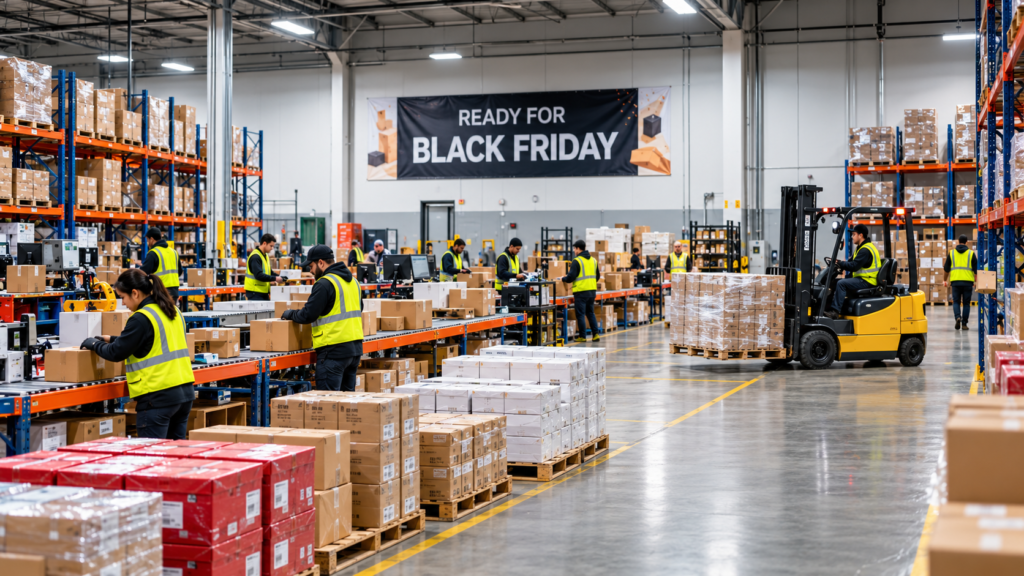
Black Friday workplace safety is the review an Ontario employer runs before the late-November peak, checking whether existing controls still hold once volume, staffing and layout change. Black Friday 2026 falls on 27 November, and the operational change starts well before that date.
A distribution centre may be processing more pallets and deliveries within days. A retail store is receiving extra stock, extending shifts and serving more customers at once. The hazards are not new. What changes is whether the controls that managed them in October still work in November.
Why the Black Friday period is different
Higher volume puts more people and goods through the same space. A receiving area that works on a normal Tuesday becomes crowded when deliveries overlap with order picking. In a store, promotional displays and restocking carts narrow the routes used by staff and customers at the same time.
Time pressure does the rest. Workers skip a handling aid, take a shortcut through an equipment route, or leave packaging in an aisle to finish an urgent task. None of those decisions look unreasonable in the moment.
The hazards that intensify
These four are the familiar ones, and they behave predictably under volume. Our warehouse peak season guide works through each in detail with the applicable provisions. The short version:
Forklift and pedestrian traffic. More pallet movement means more crossings. Blind corners, reversing equipment, blocked sightlines and temporary storage can push people into vehicle routes. This is a traffic-planning problem, not just an operator problem. Under section 51(2)(a) of Ontario’s Regulation 851, lifting devices must be operated by a competent person or a worker being instructed under the supervision of a competent person. Competent forklift operators also need to understand workplace-specific hazards. Review our forklift training and certification
Slips, trips and obstructed routes. Shrink wrap, cartons, spills and stock carts. In retail the additional question is whether display stands, delivery boxes or queuing customers narrow an evacuation route.
Manual material handling. Repeated lifting from crowded shelves at speed. Clause 45(a) of Regulation 851 requires material to be lifted, carried and moved with precautions that ensure the work does not endanger a worker.
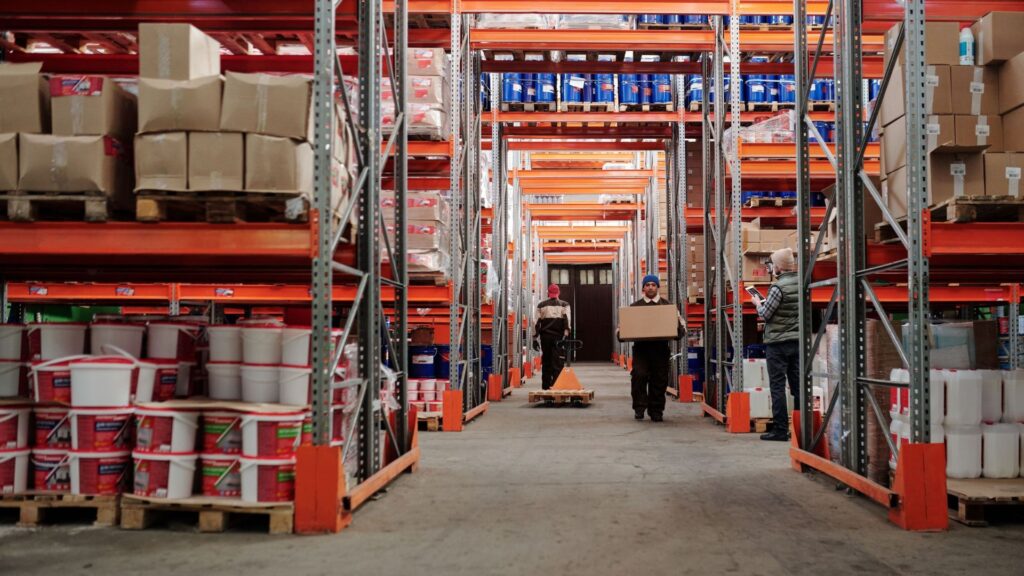
Stacking and storage. Overflow inventory in locations never intended for storage. Clause 45(b) requires material to be stored so it will not tip, collapse or fall.
One storage change worth checking before you make it
Item 3 in the table to section 7 of Regulation 851 requires a Pre-Start Health and Safety Review where material is stored on a rack or stacking structure. Subsection 7(7) exempts racking designed and tested to current applicable standards, and most suppliers provide that documentation.
A fresh review can be triggered by changing the kind of lift truck used to load the rack, by stored load type or weight deviating from the original design parameters, or by exceeding the manufacturer’s stated load limits. All three are decisions businesses make to cope with seasonal volume. A PSR is not something to arrange in the third week of November.
What is different about retail
Warehouse guidance does not cover the floor, and the floor is where most Black Friday risk sits for a store.
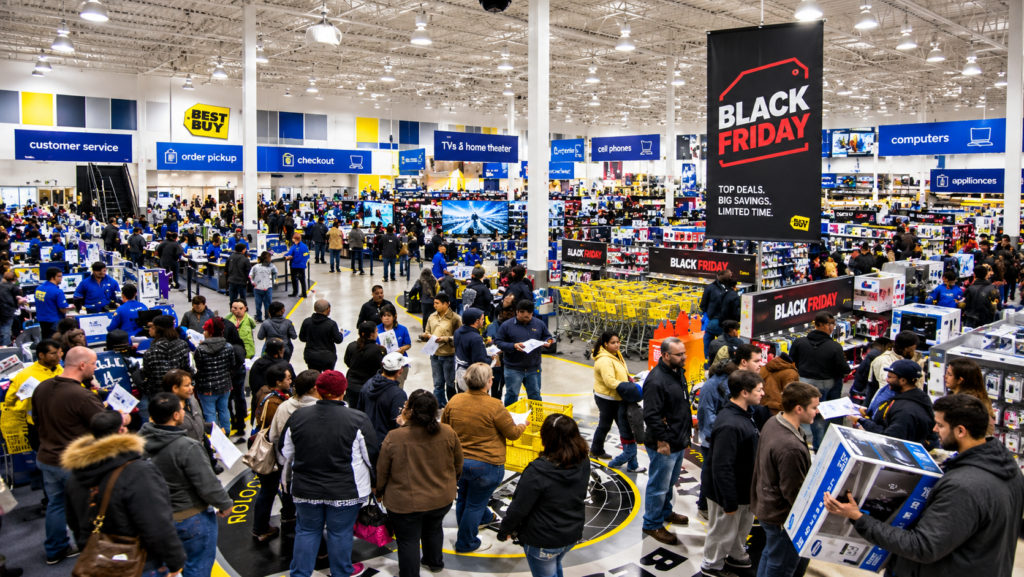
Customer flow is a safety control. Where unusually high traffic is expected, queue location determines whether crowds block doors, fire exits or the routes staff use to restock. Decide those positions before the day, not during it.
Restocking happens during opening hours. A warehouse can stage work around customers. A store cannot. Staff move stock through aisles occupied by the public, which changes how carts are loaded, where they are parked and whether a spill gets cordoned or just mopped around.
Promotional displays move. A display built on Thursday can narrow an evacuation route that was compliant on Wednesday. Whoever signs off the display should be checking egress, and that is usually not the person who built it.
Stockroom pressure rises first. Overflow goes somewhere, and in retail that somewhere is often a stockroom sized for normal weeks. Leaning stacks, goods near emergency exits and workers climbing shelving instead of fetching the step ladder are the predictable results.
Hours extend in both directions. Early deliveries and late closes compress the recovery time between shifts, and seasonal staff are often the ones taking them.
Seasonal workers: the requirement most employers miss
Peak hiring is where compliance gaps open, and the position is clearer than most drafts suggest.
Ontario Regulation 297/13 requires every worker to complete a basic occupational health and safety awareness training program as soon as practicable. It applies regardless of employment status, which includes temporary, seasonal, casual and agency workers. There is no probationary grace period and no small-employer exemption. Supervisors must complete a separate supervisor programme. Section 4 requires the employer to keep a record of the training completed.
A worker who completed the programme with a previous employer does not have to repeat it, provided they supply proof and the new employer verifies the content matches what the regulation requires. That verification is the employer’s responsibility and is the step most often skipped.
Awareness training is generic by design. It says nothing about your building. Site-specific orientation covering traffic routes, emergency exits, the equipment a worker is authorised to use and the tasks they are assigned is a separate duty under clause 25(2)(a) of the Occupational Health and Safety Act. A short walkthrough with a practical check of understanding is worth more than a procedure handed to someone who has not had time to read it.
One more threshold. Section 9 of the Act requires a Joint Health and Safety Committee where twenty or more workers are regularly employed, with at least two certified members, one representing workers and one representing management. A business that sits below twenty for most of the year can cross that line during a seasonal ramp-up. Certification requires two separate courses, and Part 2 must be completed within twelve months of Part 1.
Fatigue and time pressure
Longer shifts, schedule changes and repetitive work affect attention and judgement. Plan breaks and staffing around expected peaks rather than assuming people can work faster. Check whether overtime and back-to-back shifts leave enough recovery time, particularly for seasonal staff taking the hours nobody else wants.
What to do before the rush
Walk the site as it will operate at peak, not as it looks today. Take the route a picker takes with a full cart, or the route an associate uses restocking during opening hours. Cover receiving docks, pick aisles, stockrooms, customer routes, exits and every temporary storage location. Record each issue, who owns it and the date it closes.
Confirm who is responsible for what. Loading bays, clearing obstructions, equipment checks, responding to reported hazards. Review near-miss reporting with supervisors, including how a worker raises a concern mid-shift without stopping the line.
Brief the changes at handover. If layouts or processes change, the instruction changes with them. Retail teams also need to know who manages queues and customer flow when those arrangements are in place.
Check equipment and handling aids. Pre-use checks and maintenance for forklifts, pallet trucks, ladders and anything else running longer hours. Remove unsafe equipment from service. Confirm handling aids are positioned where the work actually happens, not stored where they are tidy.
Training to review before the season
Forklift operation. Confirm operators are trained and have demonstrated competence on the equipment and the conditions they will face. Competency attaches to the class of truck, so an operator evaluated on a counterbalance forklift has not been evaluated on a reach truck or an order picker. Any machine brought in for the season needs covering.
Awareness training. Every worker and every supervisor, as set out above, with records on file.
JHSC certification. Where a committee is required, certified members can surface concerns from inspections and worker feedback and recommend corrective action. Check whether your certified members are current and whether refresher training is due.
Working at heights, where it actually applies. Ontario’s Chief Prevention Officer-approved working at heights training is mandated under O. Reg. 297/13 for workers on construction projects who use specified fall protection systems. It is not a blanket requirement for ordinary retail shelf stocking. Assess the task and the fall hazard before buying training you may not need, or skipping training you do.
Black Friday workplace safety checklist
- Walkways, aisles and emergency exits remain clear as stock arrives
- Forklift routes, pedestrian paths and crossing points are identified and managed
- Stored materials are stable, and racks and pallets are checked for damage
- Any new rack, new forklift class used to load it, or change in load type or weight has been checked for Pre-Start Health and Safety Review applicability
- Loading and unloading procedures are reviewed with affected workers
- Queue positions and customer flow are planned so crowds do not block exits or restocking routes
- Promotional displays have been checked against evacuation routes
- Every worker, including seasonal and agency staff, has completed awareness training under O. Reg. 297/13, with the record on file
- Supervisors have completed the supervisor awareness programme
- Temporary and seasonal workers have received site-specific orientation and task instruction
- Equipment checks and safe operating procedures are current
- Supervisors know their responsibilities and the hazard-reporting process
- Shift plans account for workload, staffing, breaks and fatigue
- Seasonal hiring has been checked against the twenty-worker JHSC threshold
- Every inspection finding has an owner, a corrective action and a follow-up date
Start with what is changing
Vehicle traffic, storage, stock movement, staffing and customer flow. Walk the site, correct what you find, brief the changes and confirm workers can do the task safely. Then keep checking once the volume arrives, because the pre-season review is a starting point rather than a finish line.
Book seasonal training before the ramp-up. PHASCORP delivers forklift operator training and evaluation, JHSC certification and awareness training, at our Brampton centre or on site on your own equipment. Call (647) 564-6824.
Frequently Asked Questions
What are the most common workplace safety risks during Black Friday?
Forklift and pedestrian interactions, slips and trips, manual handling, unstable storage, loading area hazards and fatigue. In retail, add customer flow blocking exits and restocking during opening hours.
Do seasonal and temporary workers need safety training in Ontario?
Yes. O. Reg. 297/13 requires every worker to complete basic occupational health and safety awareness training as soon as practicable, regardless of employment status. Seasonal, temporary and agency workers are included, there is no probationary grace period, and the employer must keep a record. Site-specific orientation is a separate duty and is not satisfied by awareness training alone.
Does a worker have to repeat awareness training at a new employer?
No, provided they completed a programme covering the required content, supply proof of completion, and the new employer verifies the content matches the regulation. The verification is the employer’s responsibility.
Does seasonal hiring affect our Joint Health and Safety Committee obligations?
It can. Section 9 of the Act requires a committee where twenty or more workers are regularly employed, with at least two certified members. A business below that threshold for most of the year may cross it during a ramp-up, and certification takes two courses.
When does seasonal storage trigger a Pre-Start Health and Safety Review?
Item 3 in the table to section 7 of Regulation 851 requires a PSR where material is stored on a rack or stacking structure, with an exemption under subsection 7(7) for racking designed and tested to current standards. A fresh review can be triggered by changing the class of lift truck used to load the rack, by load type or weight deviating from the original design parameters, or by exceeding the manufacturer’s load limits.
Is working at heights training required for retail shelf stocking?
Not as a blanket rule. Ontario’s CPO-approved working at heights training is mandated under O. Reg. 297/13 for workers on construction projects using specified fall protection systems. Assess the task and the fall hazard rather than assuming either way.
Why does forklift safety matter more during peak periods?
More goods movement means more vehicle and pedestrian interaction. Clause 51(2)(a) of Regulation 851 requires a lift truck to be operated by a competent person, and competency includes knowledge of the dangers in that specific workplace. Those dangers change when aisles narrow and traffic doubles.
When should a business start preparing for Black Friday?
Before the extra stock, workers and deliveries arrive. Allow time to inspect, correct hazards, update procedures and train workers, including the lead time on any certification that turns out to be required.