
Custom Safety Training Development
Generic safety training satisfies a line on a matrix. It does not always satisfy the obligation behind it.
Clause 25(2)(a) of the Occupational Health and Safety Act requires an employer to provide information, instruction and supervision to protect a worker. What that means in practice is determined by the work being performed, the equipment being used and the hazards actually present. A course written for a general audience cannot address a hazard it does not know exists.
PHASCORP develops training programmes built around a specific workplace: its equipment, its documented procedures, its physical layout and its identified hazards.
Discuss a training development project: (647) 564-6824
When custom development is warranted
The workplace contains hazards no off-the-shelf course addresses. Specialised equipment, unusual processes, or a combination of hazards that no general curriculum anticipates.
An audit or inspection has identified a training gap. Where a finding concerns the adequacy rather than the existence of training, a further generic course rarely resolves it.
Procedures exist but are not being followed. This is frequently a training design problem rather than a compliance problem. Workers follow procedures they understand, and that match the work in front of them.
Training is being delivered internally without a defined programme. Many organisations conduct on-the-job instruction that is genuine and effective but entirely undocumented, which leaves nothing to produce when an inspector asks.
The organisation operates in a sector with non-standard regulatory exposure. Aerospace, railway operations, food processing and healthcare each carry requirements a general Ontario safety curriculum does not cover.
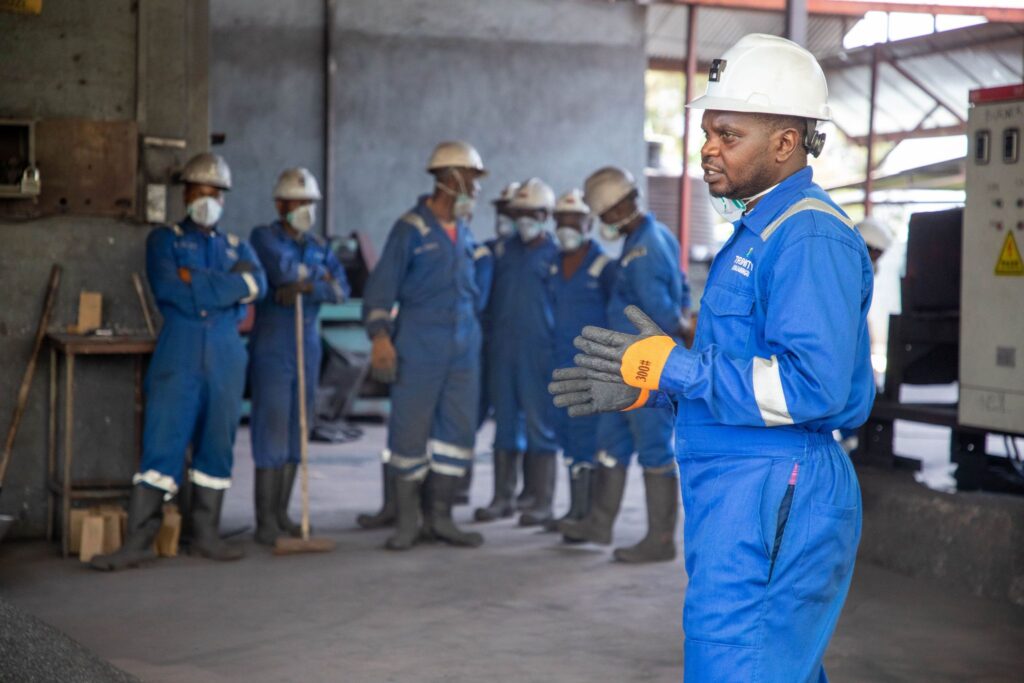
What a development project produces
A documented training programme aligned to the applicable regulation and standard. Lesson content and instructor materials. Participant materials written for the actual audience, including reading level and language. Written knowledge assessments. Practical evaluation instruments where competency must be demonstrated rather than described. Records and documentation templates that satisfy an inspector or auditor. Where required, instruction of your internal trainers in delivering the programme.
Working from the hazard rather than the catalogue
A development project begins with the workplace, not with an existing course. We review the applicable regulations, your documented procedures, your equipment and your hazard assessments, and observe the work being performed. The training programme is then written to close the distance between what workers are required to do and what they currently know.
This sequence matters. Training written before the hazard assessment reflects the assumptions of whoever wrote it. Training written afterwards reflects the workplace.
The connection to certification
The consultants who develop your training programme belong to the same team that certifies your operators on forklifts, elevating work platforms and cranes. Where a programme requires both a documented curriculum and certified operators,
both can be delivered under one engagement and against one set of procedures.
This is the practical difference between a consulting firm that trains and a training vendor that also consults.
Cost
Quoted per project, according to the number of programmes required, the complexity of the hazards addressed, whether practical evaluation instruments are needed, and whether internal trainers require instruction in delivery.
Request a scoping call: (647) 564-6824 or info@phascorp.com

Yes. We develop health and safety training programmes tailored to a specific workplace, covering its hazards, equipment, documented procedures and regulatory requirements, together with the assessment instruments and records that support them.
A standard course addresses hazards common to a general audience. A custom programme addresses the hazards present in your workplace, using your equipment and your procedures, and is documented so that it can be produced as evidence of the instruction required under clause 25(2)(a) of the Occupational Health and Safety Act.
Commonly after an audit or inspection identifies a training gap, where procedures exist but are not being followed, where internal instruction is taking place without documentation, or where the workplace carries hazards no general course addresses.
A documented programme, instructor and participant materials, written knowledge assessments, practical evaluation instruments where competency must be demonstrated, and records templates. Instruction of internal trainers can be included.
Yes. Where an organisation intends to deliver the programme internally, we develop the materials and prepare the internal trainers to use them.
Training is one element of the employer’s duty to provide information, instruction and supervision. A programme developed against the applicable regulation, your hazards and your procedures, and documented appropriately, supports that duty. The employer remains responsible for ensuring the programme is delivered, that workers are competent, and that records are maintained.
Warehousing and distribution, manufacturing, aerospace, construction, railway operations, food processing, healthcare, municipal services and retail, among others. Sectors with non-standard regulatory exposure are a frequent reason organisations commission development work.
Quoted per project. Scope is determined by the number of programmes, the complexity of the hazards, whether practical evaluation instruments are required, and whether internal trainers require preparation.